Learn how to build a globally diversified portfolio from India. 8 of 12 chapters are live, covering LRS, FX, global indexes, Irish ETFs, and selecting a broker.
Foreign exchange rates shown on Google or financial websites rarely reflect the actual rate you get from banks. Banks apply spreads, margins, and additional fees depending on the channel used to execute the transaction.
I rely on the RealValue FX Engine (a tool I built) to calculate the true transaction cost and compare various forex rates.
I had written earlier about the FX Retail platform provided by RBI/CCIL. Recently, I discovered another channel — FX Retail via Bharat Connect — accessible through apps like BHIM. I knew about this when I discovered FX Retail but never seen in actual app till today.
I was able to see the Bharat Connect Forex option inside both the BHIM app and the Bank of Baroda mobile app.
Prerequisite: FX Retail Relationship Setup
To use FX Retail, you must first configure a relationship bank in the FX Retail system.
I currently have relationships set up with:
- ICICI Bank
- HDFC Bank
- Bank of Baroda
(in that order).
Banks typically assign FX spreads based on multiple factors such as:
- transaction volume
- income profile
- overall relationship value
Since I convert a meaningful amount of INR to USD (due to higher savings and significant allocation to Nasdaq 100 in my portfolio), I was able to observe how different spreads are assigned.
Observations from FX Retail Web
On the FX Retail Web portals, banks currently offer the following spreads:
| Bank | Spread |
|---|---|
| ICICI | 1.75% (default for past ~2 months) |
| HDFC | ₹0.50 per USD (Originally 1.2%) |
| Bank of Baroda | ₹0.10 per USD (Original) |
Screenshot from FX Retail
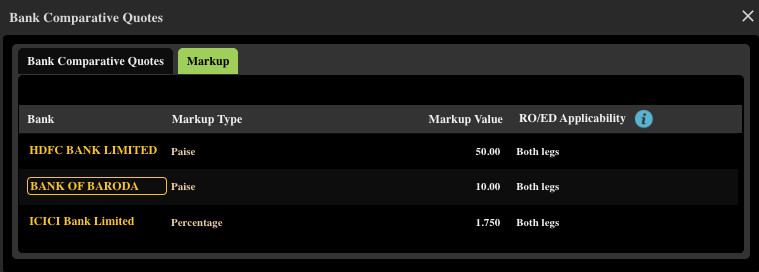
Interestingly, ICICI had offered a ₹0.90 discount on their direct banking platform, but the FX Retail Web system still shows 1.75%, which is significantly worse.
Discovery: Bharat Connect Forex
When I checked BHIM → Bills → Forex, the spreads shown were different:
| Bank | Spread |
|---|---|
| ICICI | ₹0.20 per USD |
| HDFC | ₹0.20 per USD |
| Bank of Baroda | ₹0.10 per USD |
This suggests that banks might be unofficially capped around ₹0.20/USD on the Bharat Connect channel.
I still need to verify this through an actual transaction (planning to test it with ICICI sometime).
Another interesting observation: The base price used in Bharat Connect is ~₹0.10 higher than the FX Retail Web market price.
Market Reference Rate
The mid-market rate (commonly shown on Google) at 12–1 PM on 8 April 2026 time was:
| Source | Rate |
|---|---|
| Google Mid-Market | 1 USD = ₹92.54 |
This rate is not available to retail customers. Banks always apply a markup.
FX Retail via Bharat Connect (Transactions up to ₹5 Lakhs)
Banks offering FX through Bharat Connect Forex appear to add a small fixed spread.
| Bank | Rate Calculation | Effective Rate |
|---|---|---|
| ICICI / HDFC | 92.645 + ₹0.20 | ₹92.845 |
| Bank of Baroda | 92.645 + ₹0.10 | ₹92.745 |
(I have not executed a transaction yet — this is based on the quoted rates.)
Observations
- Spread ranges from ₹0.10 – ₹0.20 per USD
- Very close to the mid-market rate
- Likely one of the most competitive retail FX options
- For HDFC it was showing both Currency/Remittance option. Whereas others I was only seeing Remittance option. Though FX Retail says Forex card supported, I couldn’t see that option at all.
Even without negotiating special rates, simply using this system could produce a very competitive effective markup.
For example: Base markup (~₹0.10 market difference) + ₹0.20 spread ≈ ₹0.30/USD
This is far better than typical retail bank rates, which can easily exceed ₹1/USD.
Further optimization may require negotiating spreads directly with banks, but ease of use vs optimisation becomes an important trade-off.
FX Retail Web
Rates shown on bank forex web portals include larger spreads or percentage margins.
| Bank | Base Rate | Extra Margin | Effective Rate | Notes |
|---|---|---|---|---|
| ICICI Bank | 92.5475 | +1.75% | ~₹94.17 | Current |
| ICICI Bank | 92.5475 | +₹0.20 | ₹92.7475 | Rate I requested |
| HDFC Bank | 92.5500 | +₹0.50 | ₹93.05 | Current |
| Bank of Baroda | 92.5500 | +₹0.10 | ₹92.65 | Current |
Observations
- For HDFC used to write email and for ICICI can be self serve for this limit setup.
- In case of BoB, I was able to set up higher trading limit upfront.
Direct Bank Quoted Rates
Rates visible directly on bank platforms at the same time:
| Bank | Standard Rate | Discounted Rate I got |
|---|---|---|
| ICICI Bank | ₹94.04 | ₹93.15 |
| HDFC Bank | ₹94.14 | — |
| Bank of Baroda | ₹93.04 | — |
Observations
The difference from mid-market ranged from roughly: ₹0.50 to ₹1.60 per USD
For larger transactions, this difference becomes significant.
Example:
| Amount | Extra Cost (₹1 difference) |
|---|---|
| $1,000 | ₹1,000 |
| $10,000 | ₹10,000 |
| $50,000 | ₹50,000 |
Bank vs Channel Matrix
| Bank | Direct Bank | FX Retail Web | FX Retail Bharat Connect |
|---|---|---|---|
| ICICI | ✅ Currently in Use (1) | ⚠️ Available but not preferred | 🟡 Planned (4) |
| HDFC | ✅ Used in past | ✅ Used in past (2) | ❌ Not planning |
| Bank of Baroda (BoB) | ❌ No | 🟡 Planned (3) | ❌ Not planning |
- Best rate I have with direct bank discount
- Best rate I transacted in FX Retail
- Best rate I have in FX Retail, yet to transact
- Backup option if 3 is not good in other aspects
Why This Matters
- If you are investing internationally at scale, FX optimisation becomes surprisingly important.
- Optimising FX spreads to invest an extra $10/month can add $24,330 (~₹22 lakhs) in real (inflation-adjusted) value over 22 years.
- Small efficiencies, compounded over time, can meaningfully impact long-term wealth.
Next steps
- To test FX Retail Web option for BoB and see how frictionless it is
- If there are issues, I will test Fx Retail via Bharat Connect for ICICI Bank